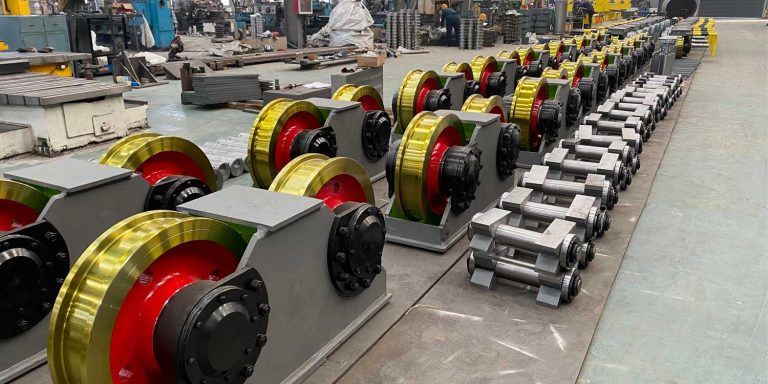

How Couplings Transfer Torque in Overhead Crane Systems
Εισαγωγή
In modern lifting engineering, understanding how Couplings Transfer Torque in Overhead Crane Systems is essential for ensuring stable power transmission and safe crane operation. In overhead cranes, couplings act as a critical mechanical link between the motor and gearbox, or between gearbox and wheel shafts, transmitting torque while compensating for misalignment and absorbing shock loads.
Στο HL CRANE, we design and manufacture high-performance crane components including couplings, crane wheels, wire rope drums, and sheaves for heavy-duty industrial applications. A well-designed coupling directly impacts crane efficiency, service life, and operational safety.
Although couplings are often small compared to other crane parts, their role in torque transmission is fundamental. A failure in coupling performance can stop the entire crane system, leading to downtime and costly maintenance.
What Is Torque Transmission in Crane Systems?
Torque is the rotational force generated by the motor and transmitted through the drivetrain to the wheels or drum. In an overhead crane system, this torque must travel through several components before reaching the final working mechanism.
The process typically includes:
- Electric motor generates rotational power
- Gearbox modifies torque and speed
- Coupling transfers torque between shafts
- Final output drives crane wheels or drum
During this process, couplings ensure that torque is transmitted smoothly without excessive vibration or misalignment issues.
How Couplings Transfer Torque
Couplings transfer torque through mechanical engagement between two rotating shafts. Depending on the type of coupling, this transfer happens in different ways:
1. Rigid Mechanical Engagement
Rigid couplings transfer torque through direct contact between two shaft ends. They provide high torque capacity but require precise alignment.
However, in overhead crane systems, perfect alignment is rarely possible due to structural deflection and dynamic loading.
2. Flexible Element Transmission
Flexible couplings are widely used in crane systems because they allow slight misalignment while still transferring torque efficiently.
They use:
- Rubber elements
- Elastomer inserts
- Gear teeth engagement
- Grid or chain mechanisms
These elements absorb vibration while maintaining continuous torque flow.
3. Gear Coupling Torque Transfer
Gear couplings are commonly used in heavy-duty cranes due to their high torque capacity.
They work by:
- Interlocking internal and external gear teeth
- Allowing angular and axial misalignment
- Transmitting high rotational force efficiently
At HL CRANE, we supply drum gear couplings designed for heavy-duty crane applications, ensuring stable torque transfer even under shock loading conditions.
👉 Related product:
https://www.hnhlcranes.com/products/crane-coupling/
Why Torque Transfer Efficiency Matters
Efficient torque transfer is critical in overhead crane systems for several reasons:
- Prevents energy loss
- Reduces vibration and mechanical wear
- Improves motor efficiency
- Extends gearbox life
- Enhances operational safety
- Ensures smooth load movement
Poor coupling performance can lead to overheating, misalignment damage, and even shaft failure.
Misalignment Compensation in Couplings
One of the most important functions of couplings is handling misalignment between rotating shafts.
There are three main types:
Angular Misalignment
Occurs when shafts are at an angle.
Parallel Misalignment
Occurs when shafts are offset but parallel.
Axial Misalignment
Occurs when shafts move closer or further apart.
Flexible couplings compensate for these conditions, ensuring that torque transmission remains stable even under imperfect alignment.
Shock Load Absorption in Crane Operations
Overhead cranes often operate under heavy and dynamic loads. Sudden starts, stops, or load shifts create shock loads that can damage drivetrain components.
Couplings help by:
- Absorbing sudden torque spikes
- Reducing stress on gearbox gears
- Protecting motor shafts
- Minimizing system vibration
This makes couplings essential for cranes operating in steel mills, ports, shipyards, and heavy fabrication industries.
Materials Used in Crane Couplings
The performance of couplings depends heavily on material selection. At HL CRANE, coupling components are manufactured using:
- High-strength alloy steel
- Forged steel bodies
- Elastomeric damping materials
- Heat-treated gear surfaces
These materials ensure:
- High torque capacity
- Fatigue resistance
- Wear resistance
- Long service life
For heavy-duty applications, alloy steel couplings are preferred due to their ability to withstand continuous cyclic loading.
Coupling Integration in Overhead Crane Systems
Couplings do not operate alone. They are part of a complete mechanical transmission system that includes:
- Motors
- Gearboxes
- Brake systems
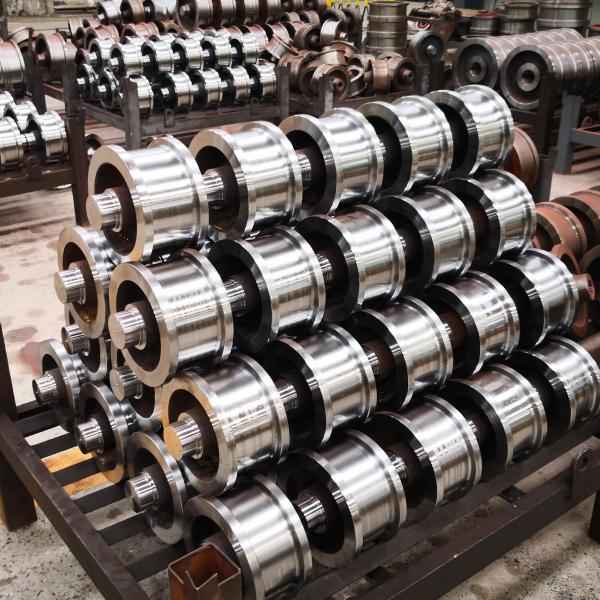
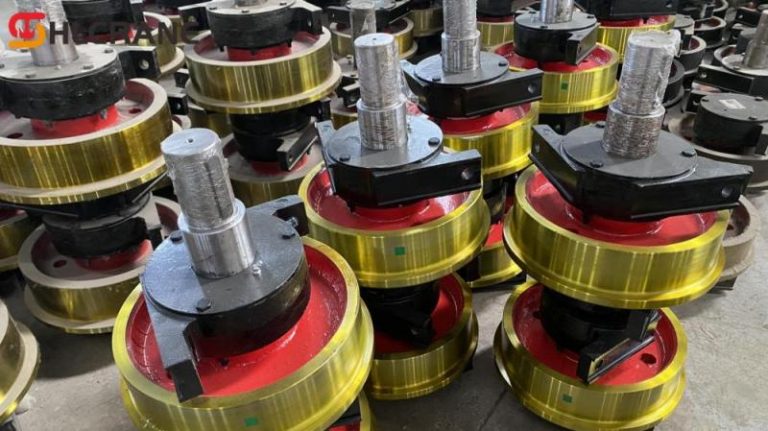
- Τροχοί γερανού
- Shafts and bearings
At HL CRANE, we manufacture not only couplings but also complete crane components to ensure system compatibility.
👉 Crane Wheel:
https://www.hnhlcranes.com/products/crane-wheels/
👉 Wire Rope Drum:
https://www.hnhlcranes.com/products/crane-drums/
👉 Crane Sheave:
https://www.hnhlcranes.com/product/crane-pulley-block/
When all components are designed to work together, torque transfer becomes smoother and system efficiency significantly improves.
Industry Standards and Safety Considerations
Coupling design and torque transmission systems are often evaluated according to international standards.
Για παράδειγμα:
- American Society of Mechanical Engineers provides guidelines for mechanical power transmission systems
- Διεθνής Οργανισμός Τυποποίησης defines quality and performance standards for industrial components
These standards help ensure safety, reliability, and consistency across crane systems worldwide.
Maintenance and Inspection of Couplings
Regular maintenance is essential to ensure long-term torque transmission performance.
Key inspection points include:
- Wear on flexible elements
- Gear tooth condition
- Lubrication levels
- Misalignment signs
- Bolt tightening condition
- Vibration abnormalities
Neglecting coupling maintenance can lead to drivetrain failure and unexpected crane downtime.
Why Choose HL CRANE Couplings
HL CRANE specializes in designing and manufacturing reliable crane drivetrain components for global industrial applications.
Our advantages include:
- Precision machining of coupling components
- High torque capacity designs
- Customized engineering solutions
- Strict heat treatment control
- Compatibility with heavy-duty crane systems
- Παγκόσμια εμπειρία εξαγωγών
We focus on delivering stable torque transmission solutions for overhead cranes operating in demanding environments.
Συμπέρασμα
Understanding how Couplings Transfer Torque in Overhead Crane Systems is essential for improving crane efficiency, safety, and reliability. Couplings play a critical role in connecting mechanical power sources to working components while compensating for misalignment and absorbing shock loads.
With proper material selection, design optimization, and maintenance, couplings significantly extend the lifespan of crane systems. At HL CRANE, we provide engineered coupling solutions designed for heavy-duty industrial environments where performance and reliability cannot be compromised.
ΣΥΧΝΈΣ ΕΡΩΤΉΣΕΙΣ
1. What is the main function of couplings in overhead cranes?
Couplings transfer torque between rotating shafts while compensating for misalignment and reducing vibration in crane systems.
2. What types of couplings are used in cranes?
Common types include rigid couplings, gear couplings, grid couplings, and flexible elastomer couplings.
3. Why are gear couplings widely used in heavy-duty cranes?
Gear couplings provide high torque capacity and can handle angular and axial misalignment, making them ideal for heavy-duty applications.
4. How do couplings reduce vibration in crane systems?
Flexible elements inside couplings absorb shock loads and dampen vibration during torque transmission.
5. How often should crane couplings be inspected?
Couplings should be inspected regularly based on operating conditions, typically during scheduled maintenance or when abnormal vibration is detected.